 |
|


|
|


I'm Online Chat Now
Certification
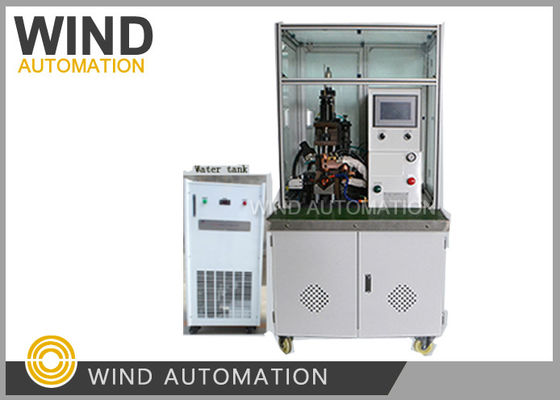
DC Power Supply Spot Welding Hot Staking Machine For Armature Commutator Fusing
|
|
Product Details:
Payment & Shipping Terms:
|



Detailed Product Description
| Condition: | New | DC Power Supply: | Self Developed DC Power Supply |
|---|---|---|---|
| Fusing Wire Size: | From 0.01mm To 1.20mm For Types Of Armatures | Welding Cooling Device: | With A Separate Water Cooling Device |
| Adjustment Easy: | The Welding Operation And Setting Is Easy For Operator | Welding Big Wire Diameter Range: | From 0.01mm To 1.20mm For Types Of Armatures |
| Electrode Cooling Method: | A Separate Chiller Cooling Tank | Gross Weight: | 662KGS Including Package Pallet |
| Highlight: | laser welding machine,arc welding machine |
||
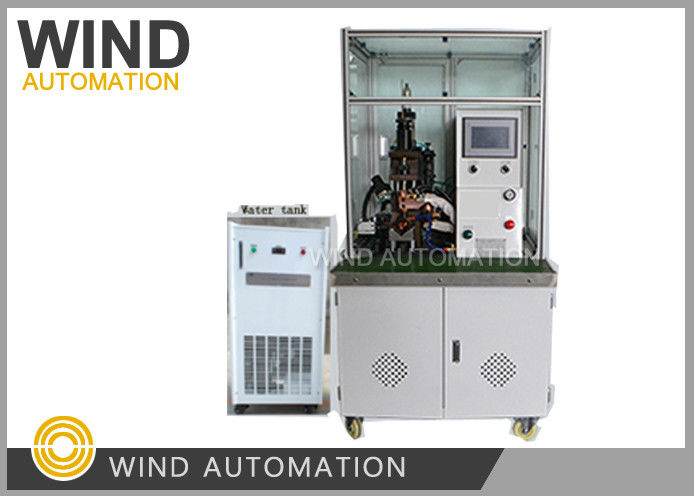
DC Power Supply Spot Welding Machine For Armature Commutator Fusing Hot Staking WIND-DC-CW003
(1) Application:
PMDC motor armature with hook commutator, riser commutator
(2) Advantages:
|
Fusing Quality Assured |
Self-developed High frequency 15KHz power supply ensure constant
fusing quality
|
|
Wide Application |
Copper wire wide adaption from 0.01mm~1.20mm(AWG44~AWG17)
|
|
Easy to Operate |
Easy for the operator,
and WIND-DC-CW003 get most repeated order among welding machine
|
Opeator friendly device installed since the year 2026

(3) History of becoming star product:
The first two pcs welding machine WIND-DC-CW003’s user was a car motor manufacturer who produce
motors and supply to BMW , they used Italy and English imported welding machine and
WIND-DC-CW003 worked as backup machine. After several months test user found welding result and quality
is same as imported welding machine and ordered 1pc more three years later.
High frequency inverter DC power supply is a trend in commutator welding, some supplier said they use
high frequency actually they use 2KHz, while Wind Automation can achieve 15KHz, with real and pure DC
power supply which achieve constant welding quality!
(4) Fusing machine Parameter:
Wire diameter: 0.01~1.2mm
Armature OD: 20~100mm
Armature stack height:10~100mm
Commutator OD:8~70mm
Airsource:5~7KG/cm2
Welding power: 10~30KW
3phase AC 380V 50~60Hz
Weight: about 350KGS
Fusing power supply: Wind Automation self developed high frequency 15KHz, 500~5000A
Control system: Japan Mitsubishi PLC
Indexing control: Japan Mitubishi servo positioning system 7'' Touch screen
(5) Feature:
Commutator spot welding machine conductor hot staking Fusing for thin or big wire High frequency
inverter weld and hot stacking commutator with small big wire thin and big wire, with separate cooling
water device (act as a conditioner)
How to acheive good fusing quality, below four factors you can check
1. Adjust the fusing current to suitable current
2. Right pressure to the fusing soldering area
3. Fusing time
4. Conductor resistance, it is related to the electrode contacting area
Please click below picture to view video
This armature commutator DC spot welding machine is a specialized device for welding motor rotors, utilizing direct current (DC) for resistance welding. Compared to traditional AC spot welding machines, it employs DC or medium-frequency inverter technology, offering advantages such as fast response speed, high energy utilization, and stable and precise welding. It effectively reduces workpiece deformation and ensures consistent weld quality.
Core Components and Working Principle armature DC spot welding machine typically consists of the following core components: Power Supply System: This is the heart of the equipment. It generally comprises a rectifier, filter, inverter, and control module. Its function is to convert the input AC power into a stable and controllable DC welding current. * Control System: Responsible for setting and monitoring welding parameters (such as current, time, and pressure) and precisely controlling the welding process according to a preset program. Modern equipment typically features multiple control modes, including constant current, constant voltage, and constant power, as well as self-diagnostic functions. * Welding Actuator: Includes clamps, electrodes, etc., used to hold the workpiece and apply welding pressure. The automated equipment also integrates a multi-axis linkage system and a rotary clamping structure to adapt to the welding needs of rotors of different specifications. The equipment's workflow typically involves placing the rotor workpiece to be welded in the designated position, and the equipment automatically completing the entire process of clamping, positioning, rotation, welding, and unloading.
Contact Details
Shanghai Wind Automation Equipment Co.,Ltd
Contact Person: Ms. Emily
Send your inquiry directly to us
More Hot Staking Machine
-
220V / 380V 50Hz Commutator Fusing Machine With Touch Screen 600KGS
-
Tig Welding No Commutator Hot Staking Machine For Integrated Starter Generator Assembly
-
70KVA Brazing Armature Colector Spot Welding Hot Stacking Machine Welder
-
Automatic Hot Staking Machine Argon Arc Welding Machine To Weld Motor
-
Wire Soldering Commutator Fusing Machine Ultrasonic Wave Metal Welding For Car Stator
-
Fully Automatic Commutator Bar Hot Staking Machine For Small DC Brushed Motor